What is Mica?
Mica is a local-first visual designer for micro-apps: small, focused,
multi-page applications such as an intake form, a profile editor, an approval
step or a checklist. You compose a micro-app on a canvas, and Mica saves it as a
plain JSON document built on the json-render
spec. A host application then renders that document with mica/runtime and
supplies whatever the document needs from the outside world — its routing, its
signed-in user, its services and its data.
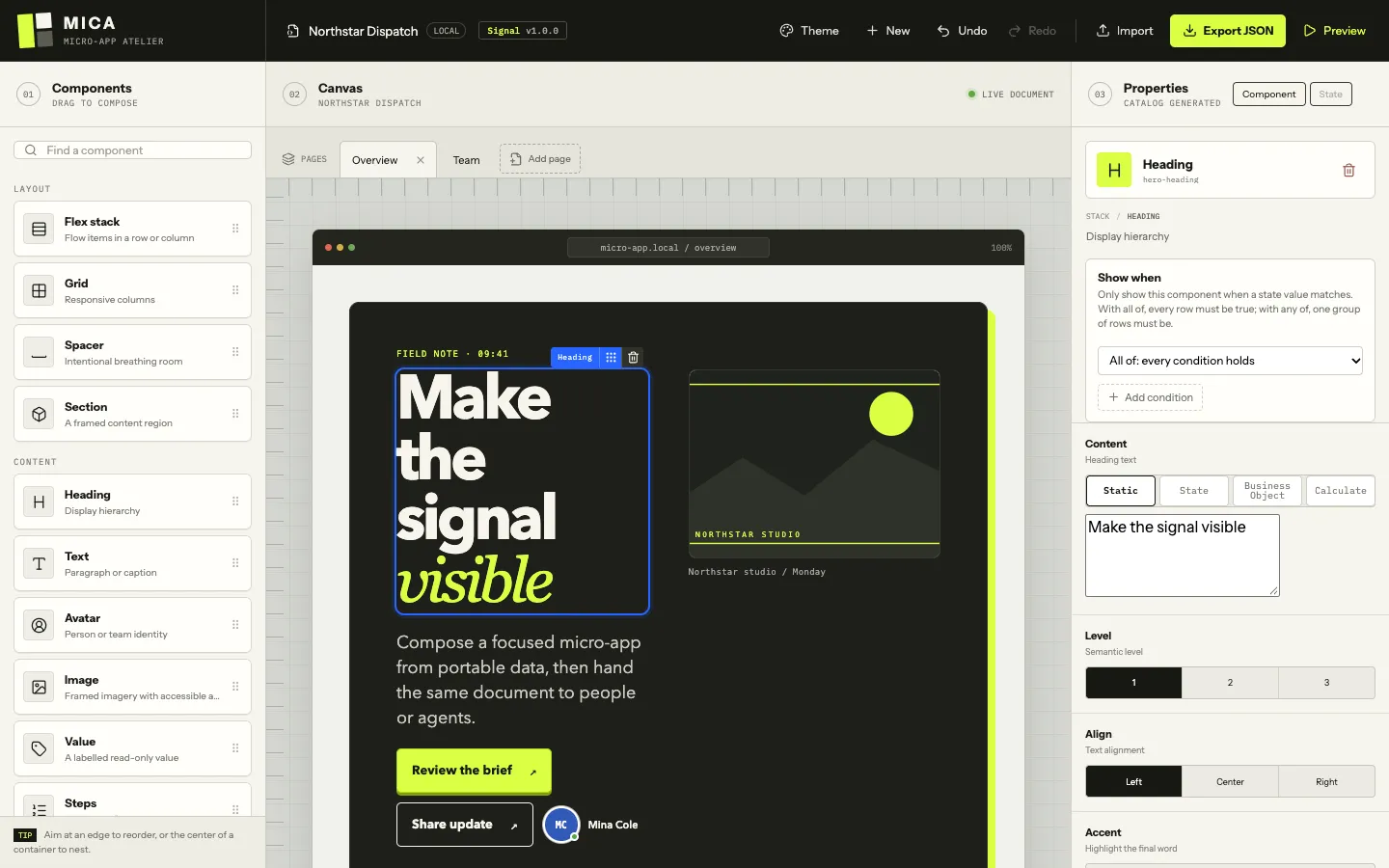
Two halves
Section titled “Two halves”| What it is | Where it lives | |
|---|---|---|
| The designer | A browser app with three panes: a draggable component palette, a live canvas, and an inspector whose controls are generated from each component’s schema. It edits one document at a time, with undo/redo, a disposable preview, and JSON import/export. | Hosted with this site. In the repository: the root (npm run dev). |
| The runtime | mica/runtime, a React entry point that renders a document with no editor code, plus the host business-object contract. mica/runtime.css is its stylesheet. |
In the repository: src/runtime.ts, built into dist-lib/ by npm run build:lib. examples/mock-host is the reference consumer. |
What a document holds
Section titled “What a document holds”A Mica document is a versioned JSON envelope:
{ "envelopeVersion": 1, "ui": { "root": "app", "elements": { "…": "…" }, "state": { "…": "…" } }, "meta": { "pack": { "id": "mica.core", "version": "1.0.0" } }, "objects": { "…": "…" }, "lifecycle": { "startup": [] }}uiis an ordinary json-render spec: a flat map of elements, each with atype,propsandchildren, plus the document state the app starts with. Elements may also carryon(what a Button does when pressed, or an Input when a person finishes editing it) andvisible(when an element shows).meta.packnames the component pack the document is built with.objectsoptionally declares the business objects the document expects a host to provide, andlifecycle.startuplists what to load when the app starts.
The document format reference covers every field. The designer never exports anything else: the page you are looking at, the selected component and drag state are editor state, not document data.
What Mica is not (yet)
Section titled “What Mica is not (yet)”Mica is deliberately bounded. These are not available in the current version, and import refuses documents that try to use them:
- Nested and reorderable lists: a list generated with
repeatcan act on a row, edit, add and remove a local list’s rows, and create, update or delete a host collection’s rows through the host, but one repeat cannot sit inside another’s template, and rows cannot be moved. - State watchers (
watch) and slots. To act when a person changes a field, use the Input’scommitevent. - Authentication, persistence and URL routing inside Mica. The host owns all of them; Mica is handed a page key and a set of handlers.
- Responsive breakpoint authoring, free x/y placement, converting a document between packs, and loading third-party packs.
The limits reference lists the exact numeric limits and the messages you get when a document goes past them.
- Open or run the designer.
- Build your first micro-app end to end.
- Read the core concepts that every guide builds on.